














Light in the Darkness of the Brain: New Horizons for the Recovery of Injured Ukrainians
Life | 08 October, 2026 at 18:06 | 209 | Author: Olena Zelenina
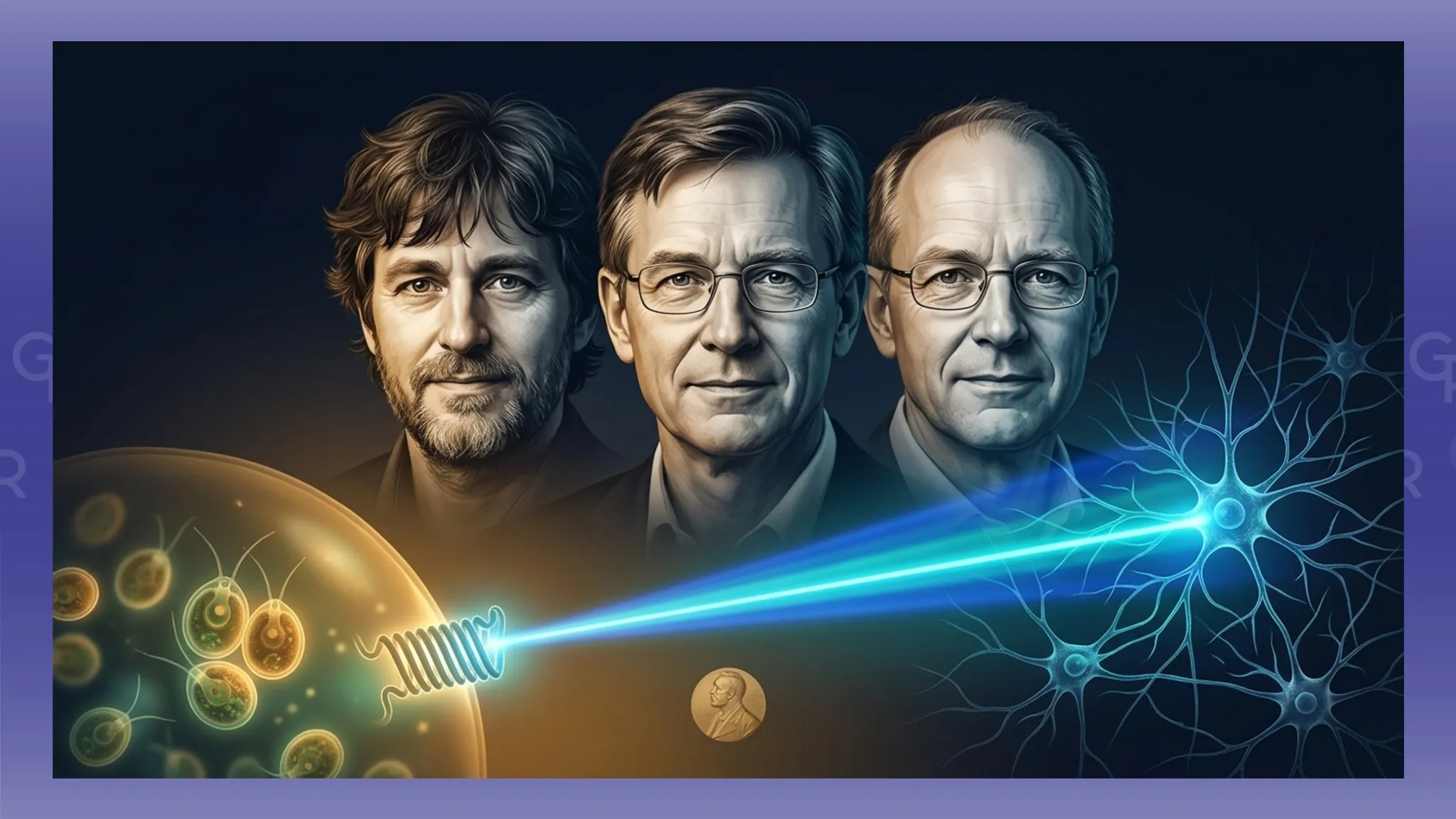
AI-illustration (Gemini) based on the author's prompt.
It all began in the early 2000s, when Peter Hegemann and Georg Nagel studied the ordinary unicellular green alga Chlamydomonas. They discovered a special light-sensitive protein inside it — channelrhodopsin. In the alga, this protein acts as a microscopic "light switch," telling it where to swim toward the sun.
The revolutionary breakthrough was made by Karl Deisseroth: he figured out how to genetically incorporate this "light switch" into brain neurons. Thanks to this, scientists gained the ability to turn a specific nerve cell on or off using a simple targeted beam of light — with millisecond precision and down to an individual neuron!
It is to them — three outstanding scientists: German researchers Peter Hegemann (Humboldt University of Berlin) and Georg Nagel (University of Würzburg), as well as American neuroscientist and psychiatrist Karl Deisseroth (Stanford University) — that the Nobel Prize in Physiology or Medicine 2026 was awarded.
Their joint discovery laid the foundation for a new era in brain research and treatment — a field of science called optogenetics.
Hope for Ukraine: Will Optogenetics Help in the Treatment and Rehabilitation of Injured Military and Civilians?
The answer is YES, but with important scientific clarifications.
As a result of the full-scale war, thousands of Ukrainian defenders and civilians suffer severe traumatic brain injuries (TBI), shell shocks, strokes, and peripheral nerve damage.
How exactly will the discovery of the Nobel laureates help in their treatment and rehabilitation?
Accurate Map of Brain Damage: Traumatic brain injury destroys complex neural networks. Optogenetics makes it possible to see "in real time" which specific brain circuits turned out to be broken or suppressed after a shock wave or shrapnel wound. This allows for the creation of much more accurate individual rehabilitation protocols.
Targeted Stimulation Instead of "Blind" Current: Traditional Deep Brain Stimulation (DBS), which is used to restore motor functions, acts on brain areas with an electric current, affecting neighboring healthy tissues as well. Optogenetics shows how to stimulate exclusively those neurons responsible for limb movement or speech, without side effects.
Treatment of Post-Traumatic Stress Disorder (PTSD) and Phantom Pain: Deisseroth is not only a neuroscientist, but also a practicing psychiatrist. Using optogenetics, scientists discovered precisely localized "neural circuits of fear, anxiety, and pain." This provides a foundation for developing next-generation pharmacological drugs and non-invasive neuromodulation methods that will be able to effectively suppress severe manifestations of PTSD, phantom pain after amputations, and chronic post-concussion syndrome.
Important Note: Optogenetics requires gene delivery into cells (gene therapy), so currently, the direct insertion of optical fibers into the human brain is at the stage of clinical trials.
However, the knowledge and models gained through optogenetics already allow for the improvement of neuroprosthetics, brain-computer interfaces, and neurorehabilitation techniques for the injured around the world today.
The 2026 Nobel Prize proves once again: research into a tiny alga can become a salvation and a hope for restoring a full life for thousands of people who have suffered severe brain injuries.

Comments
Some more relevant news for now